
Superconducting compute
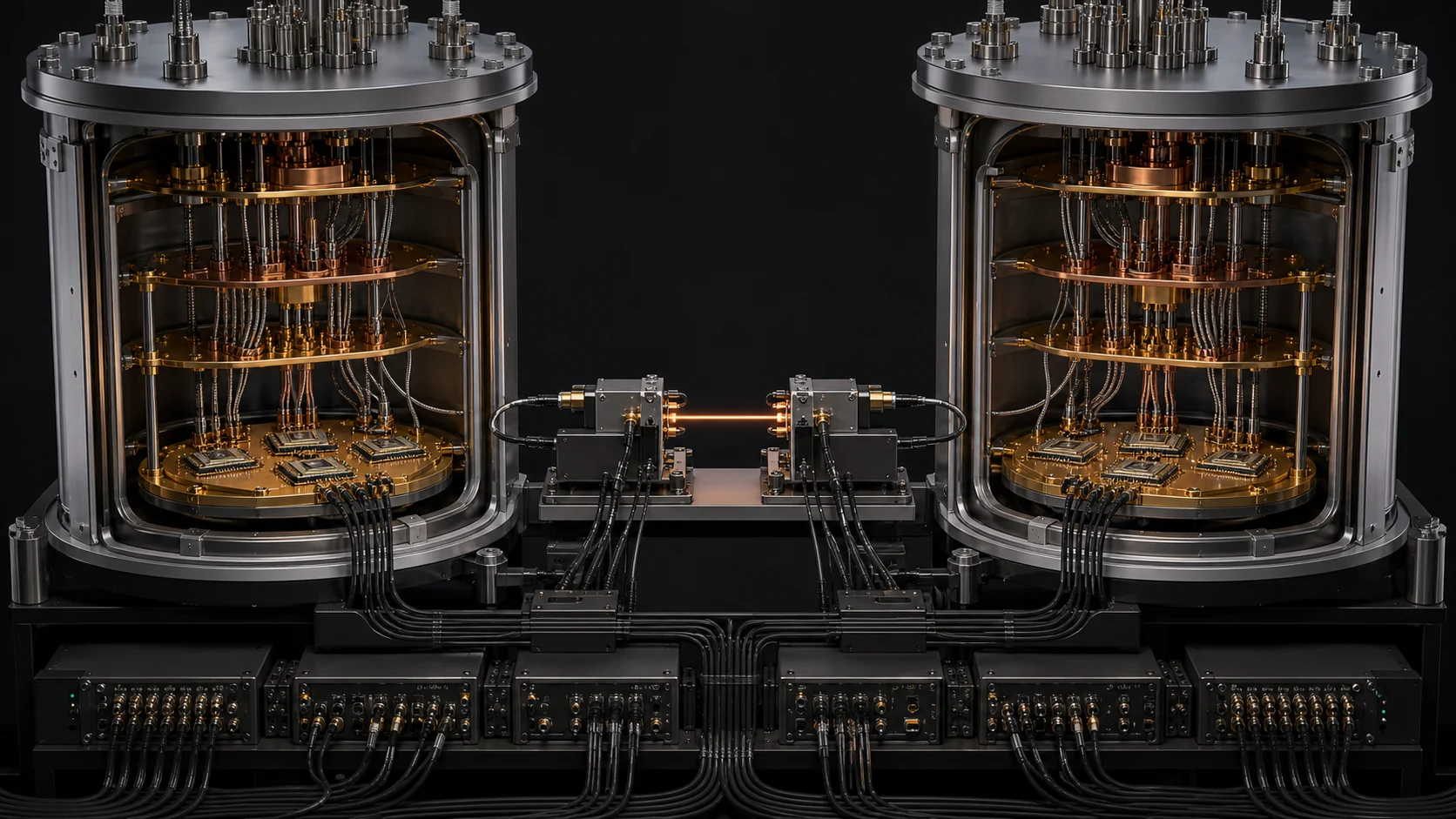
Two modules are each specified with five 100-qubit tantalum-on-silicon transmon chiplets in a heavy-hex topology, with tunable-coupler CZ gates and a target base temperature of 20 mK or below.


A modular quantum computer linked by light.
QONTOS-1 is specified as a 1,000-physical-qubit architecture formed from two superconducting modules connected through a heralded 1,550-nanometre photonic link.
The machine is an architecture-validation target, not a completed commercial computer. Its public specifications define measurable gates for devices, control, interconnect, software, and error correction; later generations remain conditional scenarios or research studies.
Two modules, five chiplets each
Tantalum-on-silicon transmons
Heralded microwave-to-optical interconnect
Architecture through logical-qubit validation
Qontos treats distributed operation as a first-class system problem: quantum modules, an entanglement link, and a real-time classical control loop must behave as one machine.
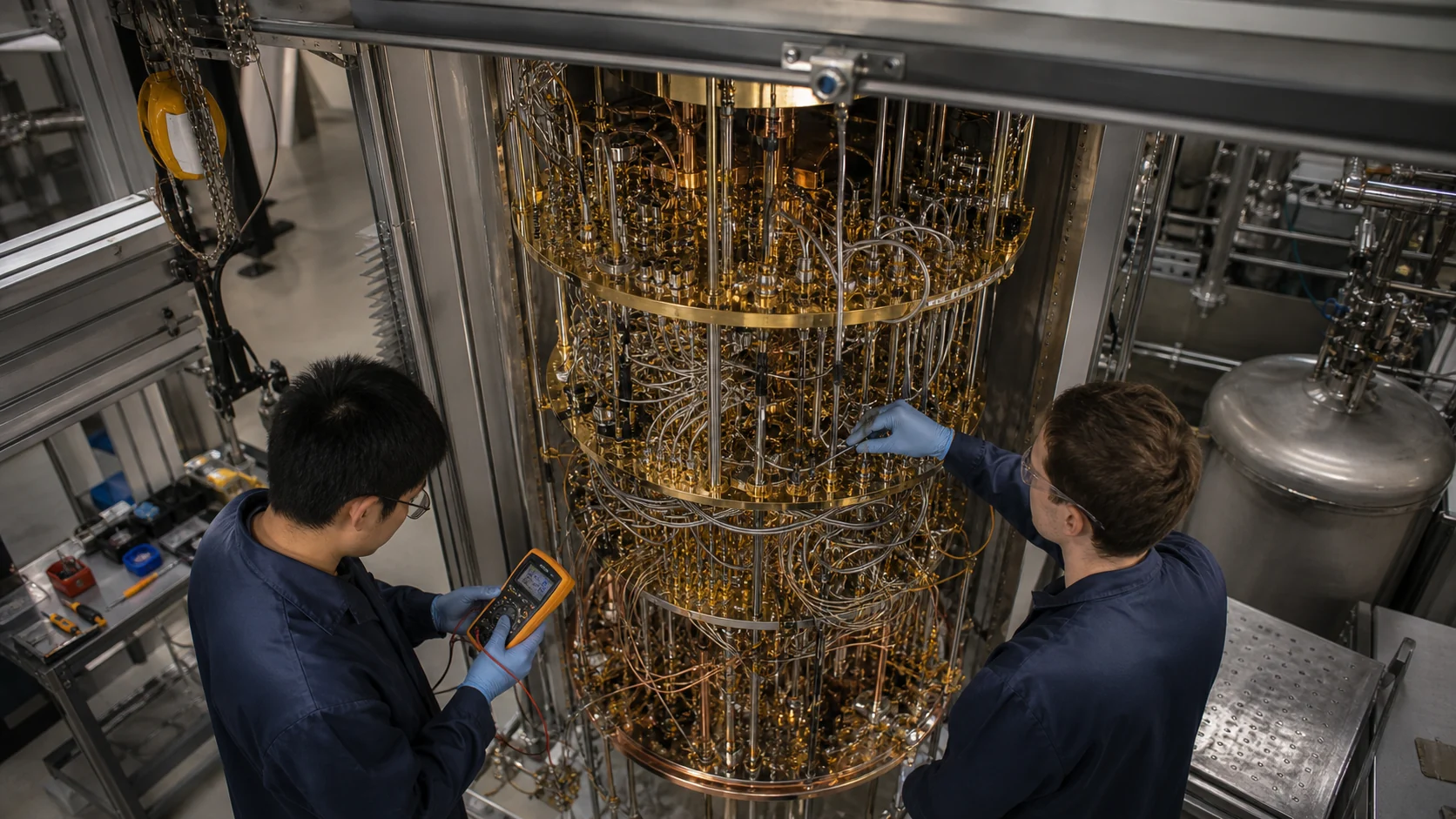
Superconducting processors operate at millikelvin temperatures while control electronics, decoders, and optical interfaces live across very different thermal and timing domains. Adding qubits without redesigning those interfaces increases integration pressure faster than useful computation.
The proposed alternative is modular. Each cryogenic unit can be engineered and accepted independently, while a probabilistic photonic channel supplies cross-module entanglement. This makes link rate, fidelity, latency, decoding, and scheduling part of the computer’s architecture rather than peripheral networking.
Two modules are each specified with five 100-qubit tantalum-on-silicon transmon chiplets in a heavy-hex topology, with tunable-coupler CZ gates and a target base temperature of 20 mK or below.
An electro-optic lithium-niobate resonator is intended to convert microwave photons toward 1,550 nm; a detector coincidence heralds a Bell pair between modules so failed attempts need not corrupt logical state.
Nanosecond-resolution waveform generation, FPGA sequencing, syndrome ingest, MWPM decoding, and feed-forward share a timing budget with local gates and the slower probabilistic link.
Target for the superconducting device layer.
Specified acceptance objectives.
With a one-microsecond stabiliser cycle objective.
Base transduction and raw Bell-pair fidelity targets.
Photonic-link objective over a five-metre reference path.
Target after syndrome processing in the real-time loop.
The runtime is the currently usable part of the programme; native QONTOS hardware is intended to join the same contract at gate G2.
Accept circuits from OpenQASM 3 and common Python quantum frameworks, then normalise them into a shared intermediate plan.
Separate work by spectral and hardware constraints, score candidate backends for fidelity, queue, and cost, and bind partitions through an ExecutorContract.
Dispatch to simulation, IBM Quantum, or Amazon Braket today; the proposed native QONTOS executor enters after first-module acceptance.
Reassemble results while retaining a three-layer SHA-256 record intended to support later replay and verification.
Two modules, approximately 10³ physical qubits, and a first distance-five logical-qubit objective.
Four to eight modules and tens of logical qubits, conditional on device and link performance.
Sixteen to thirty-two modules and a proposed 50–100 logical-qubit range.
A research vision spanning dozens of modules and hundreds of logical qubits.
A long-horizon study rather than a product commitment or dated delivery plan.